Robotic Temperature Humidity Test Chambers For Production Line
From lab bench to line station
A lab chamber sits still and waits for an engineer to load it, run a recipe, and come back days later to read the result; a line chamber lives a different life entirely, wired into a moving production line where it is one station among many and the parts never stop coming. It has to take a tray every few minutes, hold it under a fixed climate for exactly as long as the line allows, and hand it back without ever becoming the slow point that backs up everything upstream. That single change, from a box that waits to a box that keeps pace, reshapes the whole machine. Where a lab chamber can take an hour to settle, a line chamber has to recover its temperature and humidity in the seconds between one tray leaving and the next arriving, so it carries more heating and cooling reserve than its size suggests and is built to shrug off the heat a fresh load dumps in. Where a lab chamber is opened by hand, a line chamber is fed by a robot through a port or a shuttle, so its door, its racking, and its controls are designed around a machine rather than a person. And where a lab chamber answers only to its own keypad, a line chamber answers to the line controller, reporting its state and taking its orders so it starts, holds, and releases each tray in step with everything around it. It is judged not by how precisely it holds a climate in isolation but by how reliably it holds that climate while running to a clock it does not set.
The line sets the pace
A lab chamber waits for an engineer. A line chamber waits for nothing, and that single difference drives its whole design.
One arm, several boxes
A single robot rarely feeds one chamber. It serves a row of them, so the cell soaks many trays at once and the line never stalls.
What the robot handles
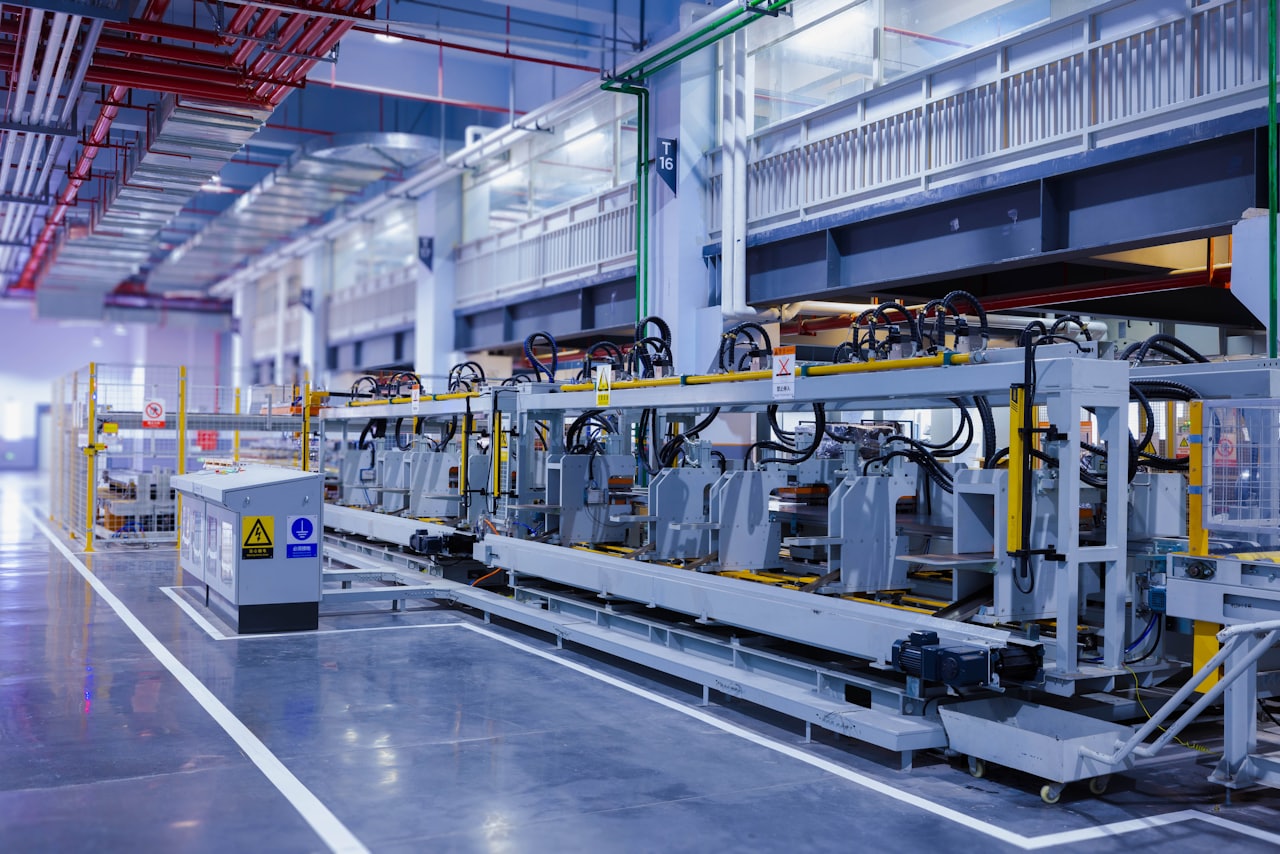
A robot on a chamber cell takes the dull, repeatable part of the job. It picks a tray off the line, indexes the load port, sets the tray on a shelf or into a magazine, and pulls it back when the profile finishes. One arm often serves two or three chambers in a row, so a single cell keeps several climate runs going at once.
Reach, payload, and cycle time decide the arm.
A light tray of phones suits a fast, slim arm. A heavy magazine of automotive modules needs a sturdier one with a longer reach and a firmer grip. The cell layout settles whether a six-axis industrial arm or a collaborative arm fits the space and the safety case, a split the guide on picking between a collaborative and an industrial loader walks through.
Burn-in as a process step
Burn-in runs a part hot, sometimes hot and damp, sometimes hot and powered, for hours so the weak units fail inside the factory rather than in a customer's hands. On a line that soak sits between assembly and final test, a station with its own takt time and its own yield target. The broad shape of that station, the soak window, the ramp, and the tray flow, lives in the overview of production-line burn-in.
The same cell, different products
The burn-in idea holds steady while the part on the tray changes the recipe and the handling around it. A phone line, a board shop, and a chip line each shape the cell to their own throughput and their own failure modes.
A consumer-electronics floor leans on a smartphone burn-in cell that cycles thousands of handsets a shift, powered and warm, watching for early-life faults. A board maker runs inline reliability screening on populated PCBAs to catch solder cracks and marginal components before the boards ship. A back-end semiconductor line wires the chamber straight into the final-test handler, so a device moves from soak to electrical test with no operator in the loop.
Talking to the line
A line chamber earns its place by reporting. Every tray carries an ID, every run carries a recipe, and the result has to land in the factory records against the right serial number. That handshake runs through the line's MES, the subject the piece on MES integration for automated chambers takes apart.
The two systems stay in step.
The chamber sends status and counts, the MES sends recipes and lot data, and a stall on one side slows the other in a controlled way instead of dropping parts on the floor.
Eyes on the tray
A pass or fail flag on its own does not sort a tray. A vision layer reads tray and unit IDs, confirms cells are seated before a run, and routes rejects to their own lane after it, work the guide on machine vision for sample sorting and tracking covers.
Running through the night
The cell pays back when the floor goes dark. An unmanned design built for round-the-clock running sets out the door seals, the interlocks, the alarm routing, and the redundancy that lets a cell soak parts at three in the morning with no one on the floor.
Why humidity is the hard part on a line
Heat on a line is steady to plan for. Humidity asks more. A board pulled cold from a soak into warm room air draws condensation onto its traces, and a wet board reads as a failed board at the next test station.
The cell manages the exit as carefully as the soak. A dry-down ramp brings the parts back toward room dew point before the door opens, a short dwell lets the surfaces settle, and the handoff is timed so a tray never sits sweating in open air while the next test station waits. Get that wrong and the line manufactures its own false failures: a board that passed the soak fine arrives at the tester carrying a film of condensation, fails an insulation check that has nothing to do with the part, and either gets scrapped or sends a technician chasing a fault that was never there. On a chamber that runs day and night, the water side, its humidifier feed and its drain, gets sized for continuous duty rather than for the odd lab run, with a supply that will not run dry mid-shift and a drain that will not back up and flood the floor at three in the morning. The wet end of the box is where a line-side chamber usually shows whether it was built for the duty or borrowed from the lab.
Throughput and the bottleneck
A line cell lives and dies on cycle time. The soak length is fixed by the product, so the way to lift output is to run soaks in parallel. One robot feeding three or four chambers turns a long dwell into a steady stream of finished trays, as long as the arm can load and unload faster than any one chamber empties.
Buffers absorb the bumps.
A short tray buffer on each side keeps the arm busy when the upstream line hiccups and keeps the line fed when a chamber runs long. Size the buffers and the chamber count against the slowest soak in the mix, and the cell holds the line's takt time instead of setting it back.
What changes in the hardware
A lab box and a line cell share a refrigeration circuit and a humidity system, then part ways almost everywhere else. The line version trades the single hinged door for a pass-through or a powered shutter, so a tray enters on one face and leaves on another. The frame grows stiffer to carry the constant motion, the casters give way to a fixed, levelled base, and the control board gains the digital handshakes a line depends on.
The inside changes too.
Shelves become indexed magazines a robot can address by slot. Sensors watch for tray presence at every position, so the controller always knows what sits where. Power feeds reach the shelves when a product has to soak while it runs, and the door seals get rated for tens of thousands of cycles rather than the few hundred a lab unit might see in a year. Each of those changes exists so a person never has to open the box.
Where the cell sits on the floor
A line chamber rarely stands alone. It anchors a cell, a small footprint that holds the chambers, the robot, the buffers, and the safety fence around them. The cell drops into the line between the station that builds the product and the one that tests it, lifting parts off the belt and handing them back further down.
Two shapes show up again and again. An inline cell passes trays straight through, entry on one side and exit on the other, which suits a fast, linear flow. A U-cell folds the path back on itself so one robot at the centre can reach every chamber, which packs more soak capacity into less floor. The pick follows the building, the takt time, and how many chambers the throughput math calls for.
Keeping a round-the-clock cell honest
A chamber that never stops still has to stay accurate. Sensor drift, a slow refrigerant leak, or a fouled humidifier shows up as a soak that misses its setpoint, and a missed setpoint on a screening step lets weak units slip through. A line cell builds in routine checks, logs every run against its recipe, and flags a chamber for service before its readings wander past tolerance.
Service has to fit around the line.
A cell with several chambers can drop one for maintenance while the others carry the load, so the line slows rather than halts. Spares for the door seals, the humidifier, and the sensors stay on the shelf, and the service window gets booked for a quiet shift instead of forced by a breakdown at peak.
Safety around a moving arm
A robot that loads a hot chamber needs a guarded space. Fencing, light curtains, and interlocked doors keep people clear while the arm moves, and an emergency stop has to drop the cell into a safe state without trapping a tray mid-transfer. The hot door and the chilled surfaces bring their own rules, since a soak at high temperature leaves parts of the cell warm enough to burn a careless hand long after a run ends.
The case for a robot at all
Hand-loading a chamber works at low volume. It stops working when a line needs a soak on every unit at full rate, around the clock, with a record tied to each serial number. A person opens a door a few hundred times a shift before fatigue and error creep in, misreads a label near the end of a long night, or sets a tray down a few degrees too early, and none of those slips show up until a test station downstream starts rejecting good parts. A person also cannot stand in front of a chamber from midnight to dawn, so a hand-loaded screen quietly becomes a day-shift screen, and the units built overnight wait in a queue that grows faster than anyone wants to admit. A robot holds the same pace at hour one and hour twenty, places every tray in the same spot to the millimetre, opens the door for the same fraction of a second each time, and writes a clean log of every move while it does it. The machine does not get tired, and the record does not come out with gaps.
The payback shows in yield and in records as much as in labour.
Steady loading means a steady soak, and a steady soak means the screening step catches what it is meant to catch. A clean, automatic data trail means the dossier behind a shipped lot holds together when a customer or an auditor asks how the parts were tested.
Why the line will not wait
A production line runs to a clock the lab never feels.
Every station has a takt time, the beat at which a part has to move on, and a chamber dropped into that line has to keep the beat or become the bottleneck that throttles the whole floor. A lab chamber can take an hour to settle and no one minds; a line cell that takes an hour has stopped production, and the cost of that idle line dwarfs the price of the chamber many times over. Sizing and buffering follow the slowest soak in the mix, with enough chambers running in parallel and enough tray buffer on each side that the robot never waits and the line never starves.
That pressure reshapes every choice.
The door becomes a fast load port, the recovery after an opening has to be measured in a few minutes, and the control has to reach the band quickly because every second spent settling is a second the line is idle. A chamber that would be perfectly good in a calibration lab can be useless on a line if it cannot keep the beat. A cell is judged less on its ultimate accuracy and more on how fast and how repeatably it cycles a tray through the same conditions, shift after shift, without drift or stoppage.
Pulling it together
A production-line chamber is a chamber wearing factory clothes. The climate science matches a lab box, while the door, the robot, the buffer, and the controller all change so the box can keep pace with the line around it. Map the product to its burn-in recipe, pick the arm to the tray, wire the cell into the MES, give it eyes and a night shift, and a row of chambers turns reliability testing from a lab errand into a step the line never has to stop for.