Foundations 07 / Buyer Basics
How to tell whether you need an office class copier or a production class one
The majority of offices never need a production copier. They need an office copier and a clear idea of where the line sits. The two classes can look alike on a showroom floor. They are built for different jobs, run by different hands and priced worlds apart.
The choice between the two classes trips buyers up because the machines share a shape. Both stand on the floor. Both print, copy and scan. Both wear a touchscreen and hold paper in drawers. One is a shared tool for a floor of people. The other is a production line for one operator.
What an office copier is built for
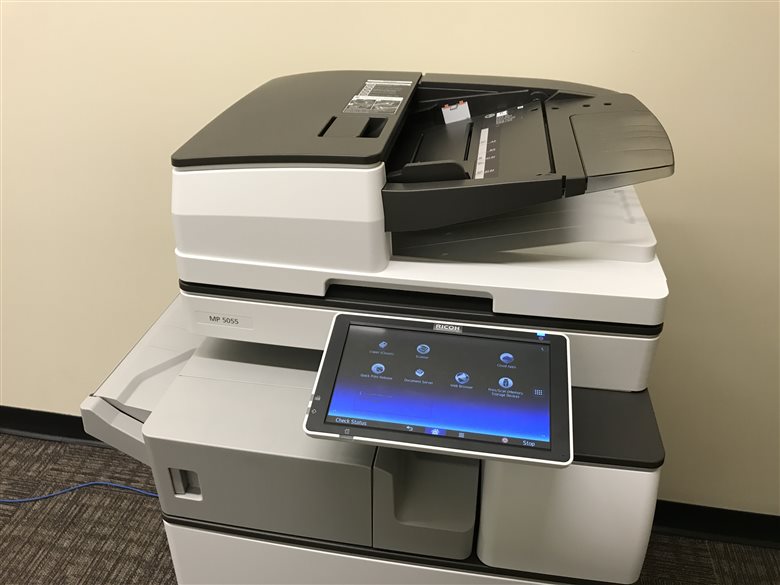
An office copier is a shared machine for everyday work. It sits in a corner or a print room and serves a floor of people who walk up to it through the day. The jobs are mixed and short. Someone prints a ten-page report. Someone copies a signed contract. Someone scans a stack of receipts to email. The machine takes a steady stream of small tasks from many different hands.
An office copier runs somewhere between 20 and 70 pages a minute. Its recommended monthly volume sits in the range of a few thousand to around 100,000 pages. It prints fast enough for a person standing at the panel and holds up to the daily load of a normal office. Past that load it begins to strain.
Office copiers themselves cover a wide range. A small workgroup machine for a handful of people runs at the lower speeds and volumes, near 20 to 30 pages a minute. A departmental machine for a busy floor runs faster and carries a heavier load, up past 50 pages a minute. Both are office copiers, since both serve a floor of walk-up users with mixed work.
What a production copier is built for
A production copier is a manufacturing machine for print. It does not serve a floor of casual users. It runs long jobs of one kind, fed by a person who operates it as part of their work. A single run might be 5,000 booklets, 20,000 mailers or a week of brochures for a print room. The work is high in volume and uniform in kind, closer to a small press than to an office tool.
A production copier runs from 70 to past 150 pages a minute. Its monthly volume reaches into the hundreds of thousands and on past a million pages. It holds its top speed for hours, on components heavy enough to take that load day after day. An office copier eases off to cool itself under a long run. A production copier keeps going at full speed from the first page to the last.
Production copiers split into kinds of their own. Some run black and white only, built for manuals, books and high-volume text at the lowest cost per page. Others run full colour for marketing work, photo books and brochures, at a higher cost and a lower top speed. A further split runs between cut-sheet machines and continuous-feed ones. Cut-sheet machines print onto separate sheets the way an office copier does. Continuous-feed machines pull paper from a roll for the highest volumes of all. An office buying its first production unit usually lands on a cut-sheet colour machine, the closest in feel to the office copier it already runs.
The real divide is staying power
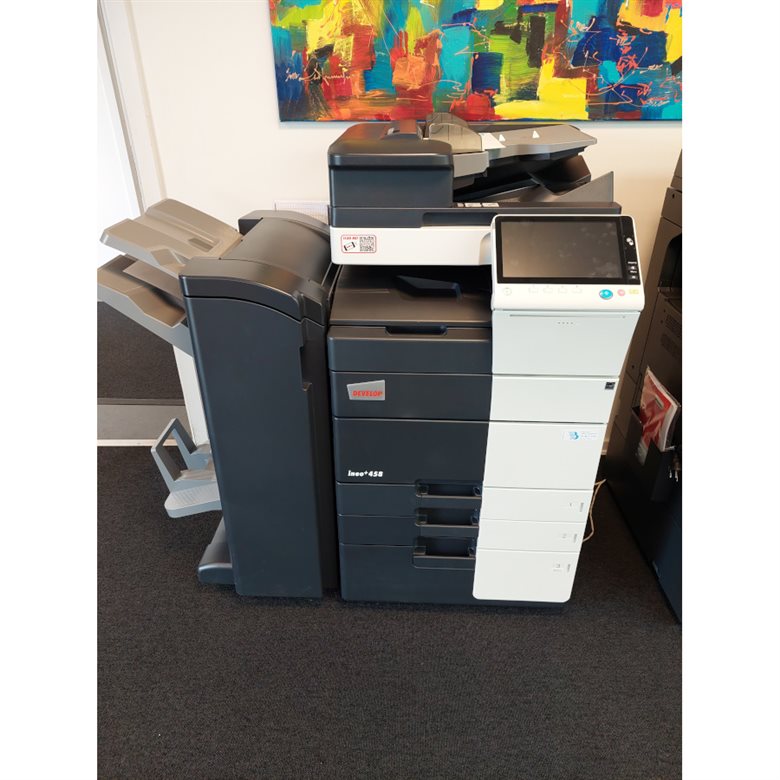
Two machines can both claim 60 pages a minute and behave nothing alike across a long run. An office copier reaches that speed in bursts. Push it through a job of ten thousand pages and it slows to protect itself from heat, then pauses to cool. A production copier holds its rated speed from start to finish, no matter how long the run lasts.
The gap shows up in hours. A run of 10,000 two-sided brochures on an office copier rated at 50 pages a minute can take six or seven hours once the slowdowns and cooling breaks are counted in. The same run on a production copier at 120 pages a minute finishes in under three, at a speed it never drops.
Two numbers on the spec sheet measure this staying power. They are easy to confuse. The duty cycle is the highest a machine can physically push out in a month, a ceiling it should never reach in normal use. The recommended monthly volume is the load the maker expects it to carry in comfort, month after month. An office copier might list a duty cycle of 100,000 pages against a recommended volume of 8,000. Running it near that ceiling every month is what wears it out early. A production copier is built so its comfortable volume sits where an office copier’s hard ceiling would be.
The slowdown has a physical cause. Fixing toner to paper takes heat. The fuser that supplies that heat can only shed it so fast. An office copier’s fuser is sized for bursts. Run it hard for an hour and it reaches its limit, so the machine slows to let the fuser catch up. A production copier carries a heavier fuser and a cooling system made to run at full output without falling behind.
Finishing is where production pulls ahead
It finishes the job in line, as the pages come off the engine. It can fold, staple, bind, trim and sort a booklet with no one touching the stack. A run of stapled handbooks drops into the tray ready to hand out. An office copier offers a slice of this, a stapler and a hole-punch on the better models. The deeper finishing belongs to production machines, the saddle-stitch booklets, the square folds, the perfect binding produced by dedicated units bolted to the side.
For many buyers, finishing settles the class. An office that produces bound booklets in-house needs the finishing a production line offers, whatever its page count. An office that prints loose pages and staples them by hand rarely touches it.
The finishing names point to real differences in the output. A booklet maker folds and staples sheets down the spine into a saddle-stitched booklet, the format of a thin manual or an event program. Perfect binding glues a thick stack into a square spine, the format of a paperback book. A folder creases sheets for mailers and letters. A trimmer squares the edges of a finished booklet so it looks printed by a shop. An office that needs any of them in quantity has found its reason for a production machine.
One is shared, one is a job
An office copier is a walk-up appliance. Anyone on the floor uses it without training, presses a button and walks away. No one owns it as a task. A production copier needs an operator. Someone is trained to load it, queue the jobs, work the finishing and keep it fed through a long run. That person runs the machine as a real part of their day.
A production copier rarely earns its place as a shared office machine. It asks for skill and attention an open floor does not give it. Left to walk-up users with no operator, it runs as a costly machine working far below what it was built to do. Without one to run it, a production copier cannot do the work it was bought for.
Waiting at the machine
Speed feels different across the two classes. At an office copier a person often stands and waits for the job, so the pages-per-minute figure is the wait they feel at the panel. A slow office copier costs the whole floor small stretches of waiting all day. At a production copier no one waits at the machine. An operator submits a run and turns to other work as it prints in the background. The speed there decides how many jobs clear in a shift.
What a production machine asks of the room
It needs space and infrastructure an office copier never asks for. The machines are large, often the size of a small car once the finishing units attach. They need clearance on every side for an operator to load paper, clear jams and pull finished work. Many draw more power than a standard wall socket gives, on a dedicated circuit. A high-volume room may need extra ventilation for the heat the machine throws off across a long day. None of this troubles an office copier, which slots into a corner on an ordinary socket.
The price gap is a decade wide
A quality office copier for a small or mid-sized business lands somewhere between 3,000 and 15,000 euros, bought outright or leased on a service contract. A production copier starts near 30,000 euros and climbs past 100,000 for a fast model with full finishing. It pays for the heavier components, the sustained-speed engineering and the finishing hardware a production run demands.
Buy a production copier for office-level work and five figures go to capacity that sits idle. Push production work through an office copier and the machine wears out early. Staff wait hours on jobs a production line would clear in minutes.
How each one is bought
An office copier is usually leased, bundled with a service contract that covers toner, parts and repairs for a monthly fee and a charge per page. The lease suits a shared machine a business runs as a matter of course. A production copier is a larger commitment, bought or leased as a capital machine, with a service agreement built around uptime and an operator’s needs. The contract on a production machine often promises a technician on site within hours. An office copier’s contract promises a fix in a day or so.
When the higher cost pays for itself
A production copier pays back its price only at volume. The machine costs far more to buy. Its cost per page on a heavy run drops below an office copier’s, since production toner and parts are priced for scale. The maths turns on how much print runs through it. A machine producing a million pages a year spreads its cost thin. The same machine producing office volumes spreads it across too little work to come out ahead.
What keeps each one running
An office copier draws toner from cartridges a user swaps in a minute. A service visit every few months covers the rest. A production copier runs on bulk toner in large containers, changed often through a heavy week, alongside drums, fusers and belts that wear faster under constant load. A production machine usually carries a maintenance plan with scheduled part swaps, since a failure mid-run is costly.
The software behind a production run
A production copier comes with software an office machine has no need for. Long jobs flow through a print server that queues them, holds them and releases them in order. A raster image processor, the RIP, turns complex files into the exact dots the engine lays down, handling fonts and images a basic driver would fail on. Colour management keeps a brand’s red the same red across thousands of copies and many days. An office copier prints from a simple driver on each computer, with none of this machinery.
The question is not how much you print
The line between the two classes gets drawn in the wrong place much of the time. People reach for a page count, a single figure of pages per month. They try to read the answer straight off it. The real question is what role the machine plays in the building. An office copier is a shared convenience. It sits on the floor for everyone, runs mixed short jobs all day and asks nothing of the people who walk up to it. A production copier is a production post. One trained person runs it, feeding it long uniform jobs and working the finishing, the way a press operator runs a small press. They are different kinds of machine doing different kinds of work. A machine that serves a floor of walk-up users is an office copier, whatever speed it reaches. A machine that gives one operator a station for turning out booklets and mailers by the thousand is a production copier, whatever speed it reaches. The page count follows from the role. A production post naturally runs six-figure monthly volumes. An office floor naturally runs less. The volume confirms the role. An office that prints 80,000 pages a month in short bursts from forty people still wants an office copier. A small shop that prints 80,000 pages a month as bound booklets from one operator wants a production machine. Forty people printing a page here and there add up to a large number that still describes office work. One operator running booklets adds up to a similar number that describes production. An office copier built to run flat out all day would cost far more than an office has reason to spend. A production copier left to sit idle between walk-up jobs would waste nearly everything it is made of.
How to read your own need
A buyer can settle the class with a short set of questions. Does one person run print jobs as a main part of the day, or does a floor of people share the machine for scattered tasks? Does the work arrive as long uniform runs, the booklets and mailers and manuals of a print operation, or as mixed short jobs? Does the output need binding, folding or saddle-stitching that comes off the machine ready to use? Do the monthly volumes climb into six figures out of genuine production runs?
A yes across those points the buyer toward a production machine. A no, which covers the large majority of offices, points to an office copier, sized up or down by the page count. The majority of businesses land on office class without a close call. The few that hesitate usually run a small in-house print operation alongside their ordinary office work, which is the case the next class was made for.
The middle ground between them
A class of machine sits between the two, sold as light production or high-volume office. These units run faster than a standard office copier, hold up to heavier monthly volumes and offer more finishing, all without reaching full production scale or price. They suit an office that has outgrown a standard copier and stops short of a true print operation. A law firm with heavy document output, a school printing constant course packs, a marketing team producing its own collateral often land here.
Is the machine a shared office convenience or a production post? A light-production unit shared across a busy floor is still an office machine, sized large. The same unit run by one person turning out bound documents all day has become a production post under another name.
Light-production machines have grown into a category of their own. They run from roughly 70 to 90 pages a minute, take monthly volumes in the low hundreds of thousands and carry booklet finishing as an option. A business that has pushed its office copier to the edge for two or three years, with print runs growing longer, often finds its answer here, short of a full production machine. The step up costs a fraction of true production gear and covers the work a growing office turns out.
Where each class fits best
A fifty-person accounting firm prints contracts, reports and statements all day from many desks, a high total in short scattered jobs. That firm wants a strong office copier, no matter how high its monthly count climbs. A small publisher turning out short-run books and manuals needs a production machine, since one operator feeds it long uniform jobs that end as bound volumes. A school falls between the two. Daily handouts are office work. The start-of-term rush of printed course packs leans toward light production.
The signs an office copier is no longer enough
The office copier sends the signals first. Print runs that once finished in minutes start tying the machine up for an afternoon. Staff begin scheduling big jobs for overnight to keep the machine free by day. The service meter sits near the recommended ceiling month after month. Someone on the team has quietly become the person who babysits long runs. The signals point to either a larger office machine or a step into light production, read against the kind of work piling up.
The move costs more than the machine
Someone has to be trained to run the machine and its finishing. Floor space has to be cleared and powered. Workflows shift, since jobs now pass through an operator on the way to the machine. None of this sinks the decision for a business that genuinely needs production capacity. A business weighing the step counts the operator, the space and the change in how work flows, next to the price of the hardware.
When print becomes the product
An office prints to support its real work, the contracts, reports and records a business runs on. A production shop prints as the work itself, turning out the booklets, books and mailers a customer pays for. Far fewer offices cross that line than the showroom floor would suggest.
Common questions
What is the main difference between office and production copiers?
The role, before the numbers. An office copier is a shared machine for a floor of people running mixed short jobs. A production copier is a machine one trained operator runs for long, high-volume print jobs with in-line finishing. Speed and monthly volume follow from that difference.
What monthly volume calls for a production copier?
Production machines suit volumes from around 100,000 pages a month into the millions. The figure alone settles nothing. A high count from a large staff doing ordinary work still points to office class. A high count from real production runs points to a production machine.
Can an office copier handle an occasional large job?
Yes, now and then. An office copier slows and pauses to cool through a long run, so a big job ties it up for hours. Run jobs like that routinely and the machine wears out early. Occasional is fine. Constant calls for a production class.
How much more does a production copier cost?
A great deal. An office copier runs roughly 3,000 to 15,000 euros. A production copier starts near 30,000 and climbs past 100,000 for a fast model with full finishing. The extra pays for durability, sustained speed and finishing hardware.
What is a light-production copier?
A middle class between the two. It runs faster and takes heavier volumes than a standard office copier, with more finishing, short of full production scale and cost. It fits an office with heavy print needs that stops short of a dedicated print operation.
Is the machine a convenience shared by a floor, or a post run by an operator? The page counts, the speeds and the finishing all sit behind that one answer.