Endurance Test Chamber For Collaborative Robot Arms
A cobot is a whole arm of six or seven joints, carrying a tool through the same move a million times while sensing the force it meets. Endurance asks whether it still lands where it should and still feels what it touches, after years of repetition.
A collaborative robot is an arm built to work at a person’s elbow. Six or seven powered joints carry a tool through the same path a million times over, while a sense of force woven through the arm lets it feel a hand in its way and stop before it does harm. Endurance testing asks a harder question than whether one joint survives. It asks whether the whole arm still lands where it should and still feels what it touches, after years of that repetition in a warm, damp, dusty plant. The chamber that runs it holds that climate around a full arm working its real cycle, then watches both its precision and its sense of touch fade.
A whole arm, not one joint
A cobot is a chain, not a part. Six or seven joints stack end to end, each a motor and a gearbox and an encoder, so the tool at the tip can reach any pose within the arm’s span. A controller blends the joints into one smooth move. A dresspack of power and signal and air lines feeds the tool through the arm. The force sensing that makes the arm collaborative runs through the whole length of it. The endurance test takes that whole machine, never a joint pulled from it.
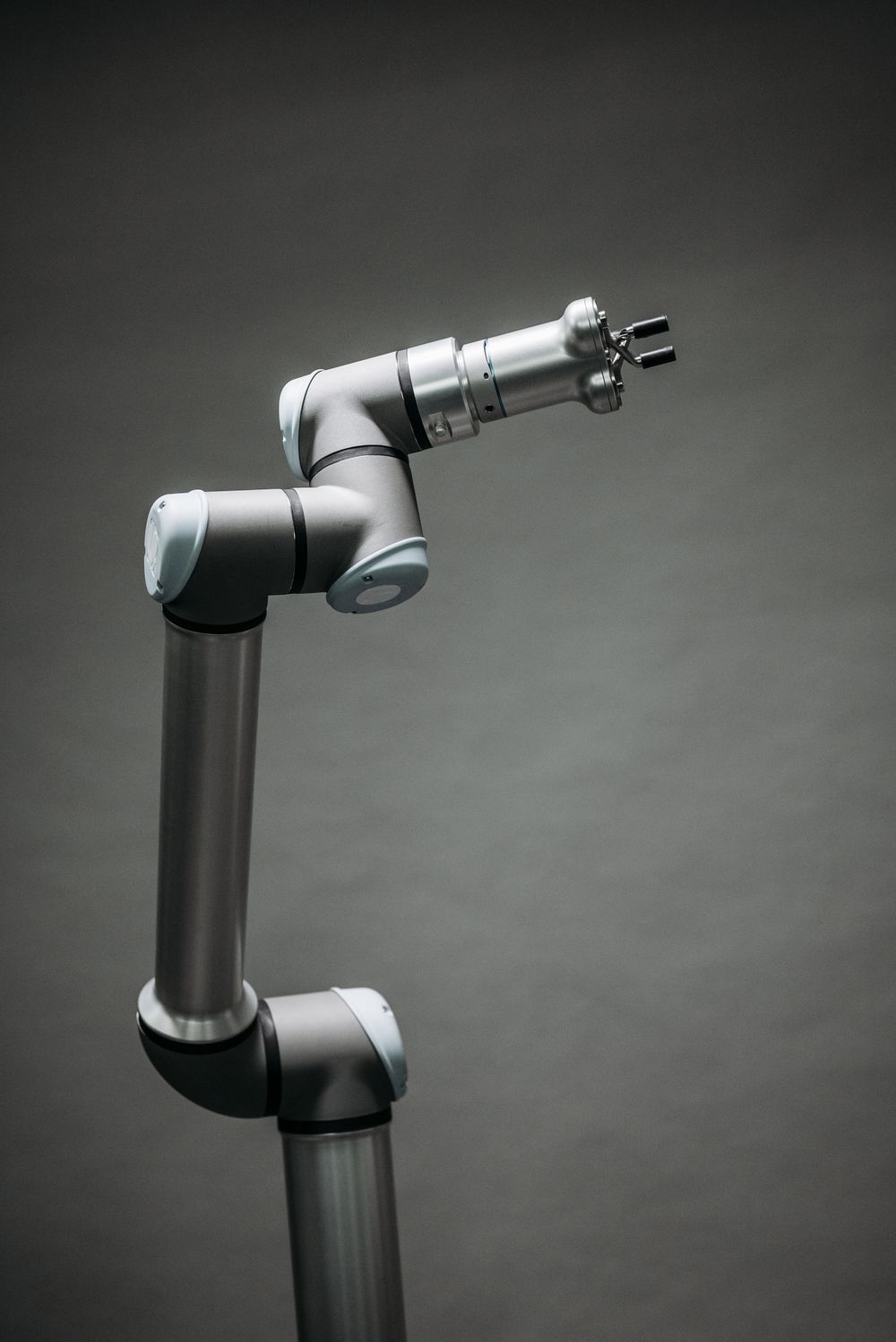
One joint can pass and the arm still fail. The joints might each test sound on a bench, then the assembled arm misses its mark or loses its feel, because the arm is more than its joints: it is the joints plus the chain that stacks them, the wiring that flexes with them, the sensing that ties them together. Endurance is a property of the whole, found only by running the whole.
The joints wear the way any actuator wears, which is its own subject. Inside each one a motor self-heats and a gearbox grinds as grease ages, the slow decline of a single actuator that a joint’s own durability test follows. The endurance test of the arm takes that joint wear as a given and asks what it adds up to across six of them in a chain, the question the joint test cannot answer alone.
What the arm adds on top of its joints is precision and safety. A chain of joints has to put the tool exactly where the program sends it, again and again, which no single joint guarantees; an arm built to work by people has to feel a touch and stop, a sense that has to stay true for the life of the machine. Those two, the precision and the safety, are what the endurance test watches fade, because they are what a cobot is bought for.
Two things have to survive
Endurance for a cobot comes down to two questions, asked together. Does the arm still land where it should, its tool returning to the same point cycle after cycle. Does it still feel what it touches, its force sense reading true so it stops for a hand. A cobot that has lost either has reached the end of its life, even if it still moves, so the test tracks both from new to worn.
Precision and safety fade by different paths, which is why both have to be watched. The arm loses precision as its gears wear and its encoders drift, a slow mechanical creep that moves the tool off its mark. It loses safety if its force sensing drifts or a safety circuit degrades, a quieter fault that hides until a contact goes unfelt. One is a problem of accuracy, the other of trust; an arm can fail at one with the other still sound.
So the chamber has to read the arm two ways as it ages it. It measures where the tool lands, to the tens of microns, again and again; it checks that the force sense still trips at the right touch. A test that watched only one would clear an arm that had quietly lost the other, which on a machine built to work by people is the gravest failure of all.
Error stacks down the chain
The reason a cobot has to be aged as a whole arm, never as a set of joints, is that its error stacks down the chain, and only the assembled arm shows what the stack comes to at the tip. Each joint sits on the one below it and carries the ones above, so a tiny play in the first joint, the slack of a worn gear or the drift of an encoder, swings the whole arm beyond it through a long lever, landing as a large miss at the tool. A joint near the base moves the tip far more than the same wear near the wrist, since it acts through the entire reach of the arm. The misses add together down the chain, six small errors compounding into one the program never asked for, so the repeatability of the arm is worse than any single joint’s, worsening as every joint in the chain wears at once. This is why a bench test of one joint, however careful, cannot stand for the arm: it sees one joint’s wear in isolation, never the way that wear is multiplied by its place in the chain and added to the wear of five others. The same stacking works on the arm’s stiffness and its feel. A little lost motion in each joint adds up to an arm that flexes more under load, droops a little further from where it should be, reads a touch a little later than it did when new. Only the whole arm, run through its real moves under its real load, lets all of that gather the way it will in the plant, the errors compounding, the flex growing, the feel dulling, until the tool no longer lands where the program sends it or the arm no longer feels the hand it should. So the endurance chamber holds and works the entire machine, every joint ageing together in the chain that ties their wear into one number at the tip, because that number, the precision of the whole arm, is the thing the test exists to measure and the thing no joint can report on its own.
Repeatability is the number
The precision a cobot is judged on is repeatability, the ability to return to the same point over and over. A good cobot holds its tool to within a few hundredths of a millimetre, often around three, returning to the same spot cycle after cycle so an assembly or a tending task lands true every time. That tightness is what the arm is bought for, what endurance puts at risk.
Repeatability is not the same as accuracy, a distinction the test rests on. Accuracy is landing on the true commanded point; repeatability is landing on the same point each time, whatever it is. A tending or assembly task needs the arm to come back to where it was, so repeatability is the number that matters, the one that drifts as the arm wears, the same move slowly wandering off the spot it used to hold.
So the endurance test measures repeatability as the arm ages. It sends the arm to a fixed point again and again, measuring where the tool lands each time, watching the spread of those landings widen as the gears and encoders wear. The cycle at which the spread grows past what the task allows is the arm’s repeatability life, the number the test sets out to find.
What endurance asks
Does the whole arm still land true and still feel a touch?
The safety that must not fade
A cobot’s safety lives in its sense of force, and that sense has to stay true for life. The arm is built to work without a cage by limiting the force it can exert and feeling what it touches, so it stops or yields before it can hurt a person. International standards put numbers on this, capping the contact force and pressure below the level that would injure each part of a human body. The arm’s force sense is what keeps it under those caps.
That sense can drift as quietly as the precision does. A force sensor that reads a little low over time, a joint that grows stiff and masks a gentle contact, a safety function slowed by a degraded circuit, each can let the arm push a touch harder than it should before it stops. None of these shows in normal work; the arm keeps running, its safety margin thinning unseen. The endurance test exists partly to catch that thinning before a person does.
So the test checks the safety as it checks the precision. It confirms the arm still senses a contact at the force it should and still stops within the distance it must, its limits held after the wear of a long life. A cobot that has drifted out of its safety limits has failed as surely as one that has lost its precision, even if it still runs its program, since the safety is the reason it can work by people at all.
Safety has more than one mode
Force limiting is one of several ways a cobot stays safe, so the endurance test has to keep them all sound. The standards for collaborative work set out a few methods: the arm holds the force and pressure of a contact below a hurt, slows or stops as a person comes near, halts on a command, with some arms also moving only while a hand guides them. A given cobot uses some mix of these, each leaning on hardware that can age.
Each mode can fade in its own way. The force limiting drifts if its sensing drifts. The slowing fails if a presence sensor or the timing degrades. The monitored stop weakens if a brake wears or a safety circuit slows. A cobot can keep doing its job as one of these quietly falls out of spec, the danger the endurance test is built to find before it reaches a person.
So the test exercises the safety, never assumes it. Through the run it checks that the arm still limits its force and still stops as it should, holding within the caps the standards set, after the wear a long life lays on the sensors and the brakes and the circuits. Safety that passed when the arm was new means little; safety that still passes when the arm is worn is what the test is for.
What wears in a working arm
The gears give up their tightness first. The harmonic drives in the larger joints, the ones near the base, accumulate backlash as their teeth wear, the slack that turns into lost motion at the tool. A cobot’s lowest joints carry the heaviest load and move the tip the farthest, so their wear shows up soonest as a loss of repeatability. Backlash building in the first joints is a common way a cobot drifts off its mark.
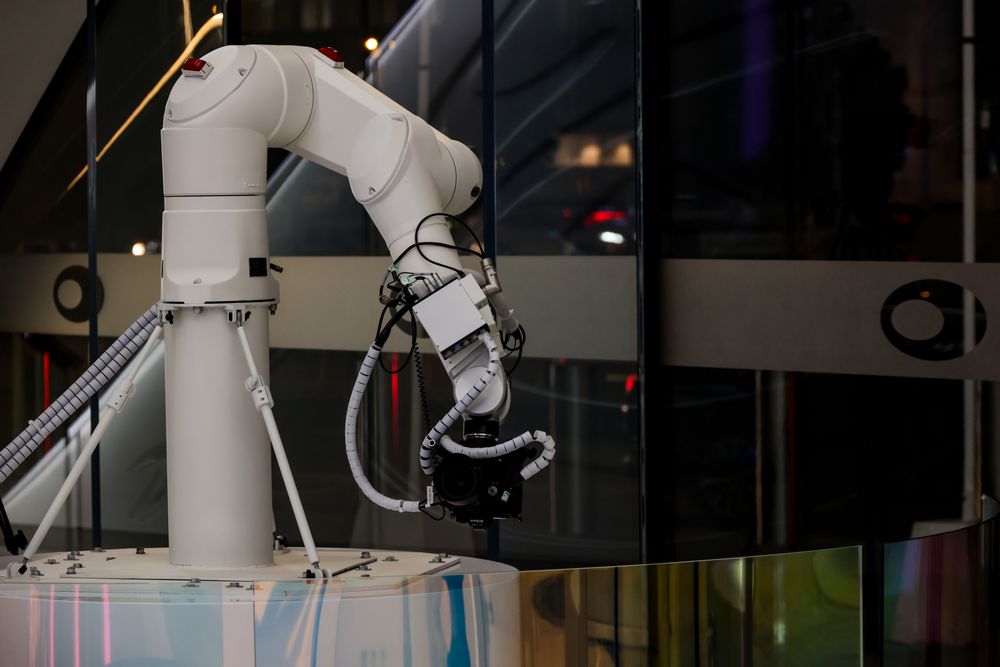
The encoders drift in their own way. The sensors that count each joint’s angle can lose their calibration over time, so the controller thinks the arm is where it is not, the tool landing off its commanded point. Encoder drift shows as a slow loss of accuracy at the tip, held off by recalibration, creeping back as the arm runs on. It is a fault the endurance test watches for as closely as mechanical wear.
The wiring and the fittings wear with the motion too. The dresspack that feeds power and signal through the arm flexes with every move, its conductors fatiguing over millions of cycles until one cracks; the seals and the brakes age; the tool at the tip wears at its own rate. A working arm is a system of wearing parts; the endurance test ages all of them at once, the way the plant will.
A life measured in uptime
A cobot is bought to run, so its life is counted in uptime. The number that matters to a plant is how long the arm runs between failures, often tens of thousands of hours when it is maintained, far less when it is not. Every hour the arm is down is production lost, so the endurance test is asking how long the arm will keep working before it needs attention.
That uptime rests on the wear staying slow and the maintenance staying ahead of it. A cobot’s gears want fresh grease at intervals and its calibration wants checking, its dresspack replaced before it cracks, the upkeep that holds the failures off. The endurance test finds the intervals, showing when each part reaches the edge of its life, so an operator can service the arm on a schedule, ahead of the failures it would otherwise meet by surprise.
Compressing a working life
A cobot’s life is too long to wait out. Tens of thousands of hours is years of running, more if the arm works in shifts, far more than any test program can sit through in real time. So the endurance test compresses it, running the arm without the pauses a real shift has, working it harder and warmer than an average day, packing years of wear into weeks.
The compression only holds if the wear keeps the same shape. Push the arm faster or hotter than it can take, and it fails by a path it never would in service, a path that tells nothing about its real life. The art is to age the arm hard along the same road it would travel in service, fast enough to finish, honest enough that the life it reaches is the life the plant would see.
The duty cycle is the test
The arm is aged by its own work, run through the cycle it will do in the plant. A cobot rarely roams its whole range; it repeats a tight loop, a pick here, a place there, the same few moves all shift. The endurance test runs that real loop, or one built to match its loads and reaches, so the arm wears the way its actual job wears it, the way a generic exercise never could.
Running the true duty is what makes the wear honest. A move that swings a heavy load through a hard reach ages the joints that carry it far faster than a gentle one, so an arm tested on the wrong cycle would wear in the wrong places and reach a life it would never have on its real job. The test has to load and move the arm as its work does, then age that forward until the arm wears out.
The payload is part of the cycle, never an afterthought. A cobot rated to carry a few kilograms ages differently empty than at its limit, the load through every joint scaling with what the tool holds, so the test runs the arm at the payload its job uses, gripping a real or a stand-in mass through the loop. An arm aged light would read a longer life than the job it does at full load would ever give.
From one arm to a fleet
A tested arm stands for many. A plant runs a fleet of the same cobot, so the life found on one, the intervals at which it wants grease and calibration and a fresh dresspack, set the maintenance for all of them. The endurance test turns a single arm’s wear into a service plan a whole floor of arms can run on.
That plan is what keeps a fleet running. Knowing when each arm will drift or wear lets an operator service it on a schedule, swapping a worn part on a planned stop ahead of the surprise failure it would otherwise hit. The endurance number, found once in the chamber, is what lets a plant run its cobots for years by plan, the arms renewed before they fall out of spec.
The plant is the climate
The environment the arm ages in is a working plant, never a clean lab. A cobot lives in warmth, in the damp of a wash-down line or a humid summer, in the dust and the oil mist of a factory floor, all of which work on its seals and its bearings and its electronics as it runs. The endurance chamber holds that plant climate around the arm, so the wear it measures includes what the environment adds, not just what the motion does.
Heat and damp speed the ageing the test wants. A warm plant softens the grease and ages the electronics faster; a damp one corrodes the metal and creeps into the joints; dust grinds where it settles. Holding those at the levels a real plant reaches, while the arm runs its duty, ages the whole machine the way its working life will, the environment and the motion wearing it together.
Different plants set different climates, so the test is built to the worst the arm will meet. An arm bound for a foundry or a wash-down line is aged in more heat or more damp than one for a clean assembly room, the chamber set to the harshest service the arm is sold into. A cobot proven in the toughest plant it will work is proven for the gentler ones too.
Reading two fades at once
The chamber reads the arm without taking it apart. At set points through the run, it sends the tool to fixed targets and measures where it lands, tracking the repeatability as it drifts; it tests the force sense against known touches, tracking the safety as it changes. The arm is measured as it is, assembled and worn, the way it will be in the plant.
Two curves come out of the run, one for each thing that fades. The repeatability curve bends out as the landings spread; the safety margin curve drifts as the force sense and the stopping change. The arm reaches its life when either curve crosses the line the job draws, a precision too loose to work or a safety too drifted to trust, whichever comes first. The endurance chamber exists to find that point honestly, on the whole arm, under its real life.
The reading is done without breaking the run. Measuring repeatability and force sense can be built into the cycle itself, the arm touching its targets and its test points as part of its loop, so the life curve is gathered as the arm ages, never by stopping to inspect it. A test that had to halt and tear down to measure would never see the fade as it happened, the one thing the endurance run is for.
What an honest endurance chamber provides
Everything an endurance chamber for a cobot needs follows from the one rule that the whole arm is the test, never any joint in it. The chamber has to hold the plant’s climate and run the arm’s real duty, reading both the precision and the safety as they fade, all across a life run fast. That asks more of a chamber than ageing a passive part ever does.
It has to age the arm whole. The chamber works the full assembled machine through its duty, every joint wearing in the chain that stacks their error, so the repeatability it measures is the arm’s own, the sum no bench test of a single joint could give. A chamber that aged joints one at a time would miss the one thing the cobot is judged on.
It has to hold the plant around it. The climate stays at the warmth and the damp and the dust a real factory reaches, steady around an arm that works and warms as it runs, so the environment ages the arm alongside the motion. The wear the chamber finds then includes what the plant adds, the corrosion and the softened grease and the ground-in dust, not just the turning of the joints.
It has to read both fades to the end. The chamber tracks where the tool lands and how the force sense reads, again and again through the run, so the precision and the safety are each followed from new to worn. A test that watched only the precision would pass an arm gone unsafe; one that watched only the safety would pass an arm gone imprecise. Both have to be read, because either ends the arm’s life.
Together these make a chamber that ages a cobot the way its working life will. It holds the plant’s climate and works the whole arm through its duty, reading the precision and the safety as they drift, then hands back the life the arm reaches, the cycles or the hours at which it can no longer land true or feel safe. That is the demand a collaborative arm places on the box that proves it: age the whole machine as the plant would, then find the day it can no longer do the two things it was built to do.
Common questions
What does an endurance test for a cobot arm do?
It ages a whole collaborative arm the way years of plant work would, then measures how far its performance has drifted. The chamber holds the factory’s warmth and damp and dust around the arm while it runs its real duty cycle, so the arm wears by environment and motion together. The test reports a life, the cycles or hours at which the arm can no longer hold its repeatability or its safety.
Why test the whole arm rather than one joint?
Because a cobot’s error stacks down its chain of joints; only the assembled arm shows what that comes to at the tool. A little wear in a joint near the base swings the tool far, six joints’ errors adding together, so the arm’s repeatability is worse than any single joint’s. A joint can test sound on its own even as the assembled arm drifts off its mark.
What is repeatability and why does it matter?
Repeatability is the arm’s ability to return its tool to the same point cycle after cycle, often within about three hundredths of a millimetre on a good cobot. It is what assembly and tending tasks need, differing from accuracy, which is landing on the true commanded point. As the arm wears, its repeatability drifts, the same move wandering off the spot it used to hold, which is the precision the endurance test tracks.
Why does the test check the arm’s safety?
Because a cobot works without a cage by sensing force and stopping before it hurts a person; that sense can drift as quietly as its precision. A force sensor reading low or a stiff joint that masks a contact can let the arm push harder than it should before it stops, with nothing showing in normal work. The endurance test confirms the arm still senses and stops within its limits after a long life, so its safety has not faded unseen.
How is a cobot’s life measured?
In uptime, the hours the arm runs between failures, often tens of thousands when it is well maintained and far fewer when it is not. A plant loses production for every hour the arm is down, so the endurance test asks how long it will keep working before it needs attention, then finds the service intervals that keep it running. The arm reaches its life when its repeatability or its safety drifts past what the job allows.
Part of the Envsin guide to reliability and durability testing. An endurance chamber ages a whole collaborative arm at its real duty in a plant climate, watching its precision and its safety fade together, so the life it reports is the life the arm will have on the floor.