Foundations 02 / Origins
A short walk through the history of the photocopier from Carlson to today
The story runs from a rented room in Queens to the networked machine down the office hall. It spans eighty years, one stubborn inventor and a process that has barely changed at its heart.
The machine in the corner of a 2026 office runs on a process worked out in 1938. Chester Carlson, a patent worker worn down by copying documents by hand, spent his evenings chasing a way to print without ink, plates or wet chemistry. The photocopier traces a straight line from his makeshift lab to the connected multifunction unit down the hall. It runs through a frustrated clerk, a company that bet itself on a hunch, a federal courtroom and a Cold War.
One frustrated patent worker
Chester Carlson worked in the patent department of an electronics firm in New York through the 1930s. The job ran on copies. Every application needed duplicates of dense text and technical drawings. The routes open at the time were re-typing by hand, carbon paper or sending documents out to be photographed. Each one was slow or costly. Carlson, trained in both physics and law, set out to find a fourth way.
The drive behind that search came from his own life. Carlson was born in Seattle in 1906 into a family that poverty and illness rarely left alone. His father carried both tuberculosis and arthritis. By the age of fourteen the boy was the household’s main earner. He worked his way through a physics degree at the California Institute of Technology, finishing in 1930 around 1,500 dollars in debt.
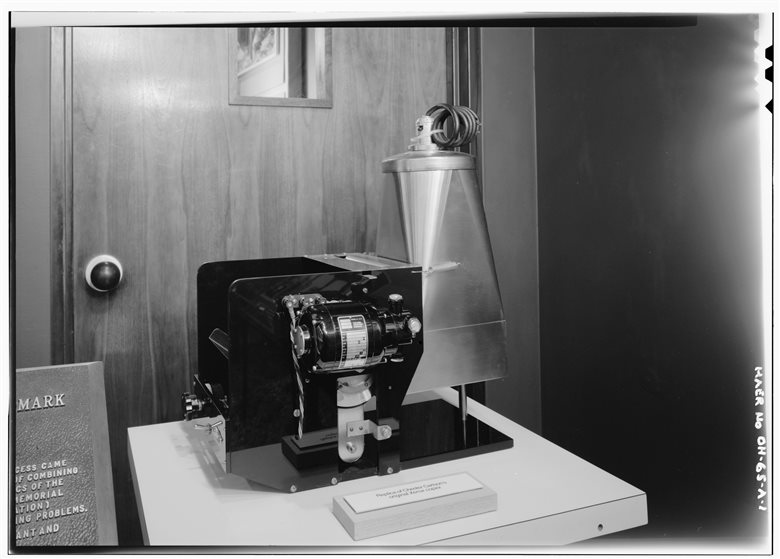
He worked from a rented room in Astoria, in the Queens borough of New York. The effect he chased was electrophotography, later renamed xerography from the Greek words for dry writing. It used static charge and light to pull a fine powder into the shape of an image, with no liquid at any stage. On 22 October 1938 Carlson and a hired physicist named Otto Kornei produced the first such image. They wrote the line 10-22-38 ASTORIA on a glass slide and copied it onto a sheet of paper. The copy was crude.
Twenty companies said no
Carlson spent the early 1940s looking for a company to turn his effect into a machine. He approached more than twenty of them, among them IBM, General Electric and RCA. Every one declined. The market for an automatic copier looked too small to justify the development cost, in the view of the firms he visited.
The first real help came from a research institute. In 1944 the Battelle Memorial Institute in Ohio agreed to refine the rough process in exchange for a share of any proceeds. Battelle turned Carlson’s hand-built demonstration into something closer to a method. It was there, in 1944, that Carlson met Joseph Wilson, who ran the Haloid Company. Wilson needed a new product to lift a firm that lived on a thinning photo-paper trade. He chose to gamble the company on the dry-copying idea.
He held the patent through the long wait. The United States granted him number 2,297,691 in 1942, years before any maker would touch the idea. Haloid itself dated to 1906, a Rochester firm built on photographic paper. It licensed the process in 1947 and put its own money into turning the effect into a working machine. That work took another full decade before it returned a product an office could use.
The copies before the 914
The office of the 1950s was not short of copiers. It had several. Each one came with a flaw. Photostat machines, around since the early 1900s, made copies on photographic paper through a camera-and-darkroom process. The 3M company sold the Thermofax, which ran on heat and special paper. Kodak sold the Verifax, a wet process on coated stock. The copies they turned out curled, faded over the months or cost dearly in supplies.
A Verifax copy ran about 15 cents in materials at the end of the 1960s. A Xerox copy ran near 3 cents, paper and labour counted in, on ordinary paper that held flat and kept its image.
The 914 puts a copier on every floor
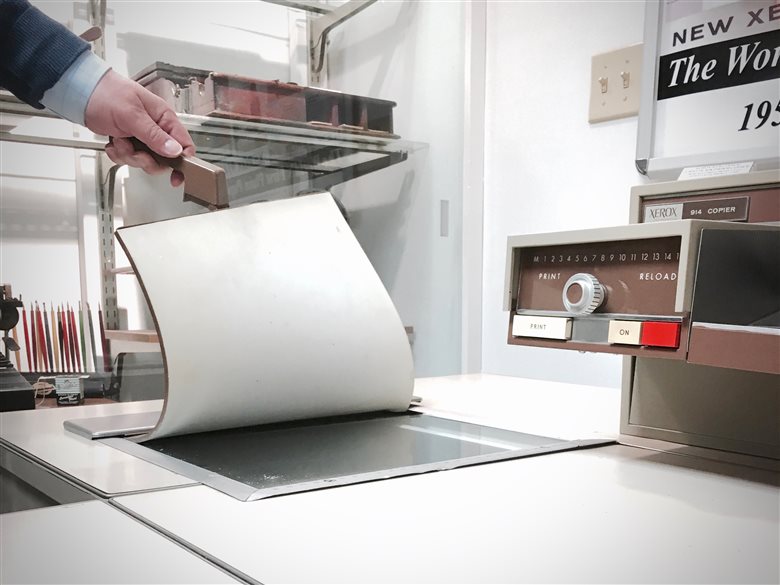
The first years at Haloid went into one hard problem. Carlson’s early version used a flat plate charged and exposed by hand. A practical office machine needed something that ran on its own. The answer was a rotating drum coated with selenium. Selenium is a photoconductor. It holds an electric charge in the dark and releases that charge wherever light falls on it. Light reflected off the blank parts of an original drains the charge from the matching parts of the drum. The dark marks of text reflect no light, so their charge stays in place. What remains is an invisible pattern of charge in the exact shape of the image. The drum turned a set of manual steps into a continuous cycle, one revolution to a copy.
The result was the Xerox 914, launched in 1959. It copied any original up to 9 by 14 inches, which is where the name came from. Haloid showed it to the public on 16 September 1959 in a live television demonstration. The machine weighed close to 300 kilograms. It made a copy in seconds, on plain paper, at the press of a button. Nothing else on the market did that at the time.
The early machine ran hot. The 914 used heat to fuse each copy. An overworked unit could set its own paper alight. Xerox shipped every machine with a small fire extinguisher and called it, with a straight face, a scorch eliminator.
Haloid leased the 914. It chose not to sell the machine outright. An office paid a monthly fee near 95 dollars, with the first 2,000 copies free and about four cents metered for each one after that. A single 914 could turn out 100,000 copies in a month. Offices pushed them that hard. Demand ran so hot that the company renamed itself after the product. Haloid became Xerox. The brand name turned into a verb.
Xerox revenue climbed from 32 million dollars in 1959 to over a billion by 1969. By 1965 some 60,000 of the machines stood in offices. It created the modern paper office, where a copy came as fast as anyone asked for one.
The patent wall comes down
For its first decade Xerox owned the plain-paper copier outright. More than two thousand patents fenced off the selenium process. The company licensed none of them. A rival had two choices. Find a different path to the same result, or stay out of the market.
Canon took the first path. In 1968 it brought out its NP process, a plain-paper copier built on cadmium sulfide in place of selenium. The new chemistry sidestepped the Xerox patents. Other Japanese firms, Ricoh and Savin among them, pressed in behind it.
The wall fell the rest of the way in court. In 1972 the United States Federal Trade Commission charged Xerox with monopolising the copier market. The 1975 settlement forced Xerox to license its whole patent portfolio to any company that asked for it. Nearly all the takers were Japanese. Within four years the Xerox share of the United States copier market dropped from near total to under fifteen percent. The machines grew cheaper and smaller as competitors crowded in.
The new entrants pushed the machine in directions Xerox had not taken. Canon and its rivals shrank the copier to fit a small office, then a desktop. They drove the price down with each generation. A machine that had been a leased 300-kilogram fixture turned into something a corner shop could own outright. Each generation came out smaller and cheaper than the one before.
From a lens to a laser
For its first years the copier was an optical machine. A lamp lit the original. A lens projected that image onto the drum, the same way a camera throws a scene onto film. The copy was a direct optical print of whatever sat on the glass.
The next leap came from inside Xerox. Gary Starkweather began the work at the company’s research site in Webster, New York, where his managers saw little promise in it. He moved to the new Xerox research center in Palo Alto to carry it through. His idea was that a laser, switched on and off at high speed and swept across the drum, could write an image point by point from digital data. A page became a grid of dots, each one marked by the laser or left blank. The Xerox 9700, shipped in 1977, was the first commercial laser printer. It ran at 300 dots per inch and reached 120 pages a minute, driven by computer data in place of a glass original.
The laser cut the copier’s tie to optics. An image no longer had to come from a lens looking at paper. It could come from a file.
The same engine could now serve two jobs. The hardware drew no line between the two.
The laser printer left the data centre for the desk over the next decade. By the mid-1980s a laser printer sat beside the personal computer, sharp and quiet next to the coarse dot-matrix machines it replaced. The same drum-and-toner process that ran the office copier now printed a memo at a desk.
The machine learns to remember
Through the 1980s the copier and the laser printer grew toward each other. The step that joined them was digital scanning. An analog copier projected the original onto the drum in one continuous optical sweep. A digital copier scanned the original once with a row of light sensors called a CCD. A charge-coupled device converts light into electrical charge cell by cell, turning the page into a grid of numbers held in memory. From that single scan the machine wrote the image to the drum with a laser as many times as asked.
Scan once, print many. A fifty-page run no longer meant fifty trips of the original across the glass. It meant one scan and fifty laser passes. Xerox marked the high end of this with the DocuTech system in 1990, a machine that turned a paper stack into a stored digital master and printed from it at the quality of a print shop. The DocuTech ran 135 pages a minute and scanned at high resolution. It let a print room turn a bound original into a stored file, then run off a hundred collated copies from it.
Once the original lived in memory as data, the copy and the print became the same act.
Memory changed the rhythm of a long job. Collation came for free.
Four machines become one
A machine that held a document as data could do more than reprint it. It could send that data to a screen, down a phone line or across a network. The copy was now a file.
Through the 1990s and into the 2000s the separate boxes on the office floor folded into one. The copier already scanned and printed. A fax board let it send a scan down a phone line. A network port let it print from any computer in the building and drop a scan into an email inbox. The standalone scanner, the standalone fax machine and the standalone desktop printer each lost the reason to exist as a separate unit. The copier absorbed the job of all three. The merge made sense on cost and on floor space. A copier already held a scanner, a drum, a paper path and a controller. A fax machine held a scanner and a phone modem. A desktop printer held a drum and a paper path. The copier carried nearly all the parts each separate box duplicated. Adding the one missing piece cost far less than buying a whole second machine.
Colour walked the same road. It added work to every step. A black-and-white copy lays down one pass of black toner. A colour copy lays down four, in cyan, magenta, yellow and black, each one needing its own charge and exposure on the drum. The early colour machines ran slowly. Faster engines and tighter registration brought colour up to office speed by the 2000s, at a price an ordinary office could meet. The machine that began as a black-and-white duplicator now ran colour print, colour copy, colour scan and fax from one chassis.
The connected copier
The machine in a 2026 office is where that line stands now. A user sends a job to it from a laptop across the room. A scan goes straight to a shared folder or an email inbox. The control panel runs an operating system, with apps and a touchscreen. A hard drive inside holds the jobs that pass through.
The work the machine does has moved onto the network with it. A scan no longer ends as paper. It lands in a document-management system, a cloud folder or an accounting package, indexed and ready to search.
People still call it the copier. The copying function is one of several it runs, rarely the busiest. A typical unit spends more of its day printing network jobs and scanning paper into digital systems than making copies of an original.
What changed and what did not
Strip away eighty years of cabinets and panels and the core of the machine is the one Carlson worked out in Astoria. A drum takes a uniform charge in the dark. Light discharges it in the pattern of the image, leaving an invisible electrostatic latent image. Charged toner powder clings to the charged areas and skips the rest. The drum presses that powder onto paper. Heat fuses it in place. Charge, expose, develop, transfer, fuse. That five-step cycle ran inside the 914 in 1959. It runs inside the multifunction unit today. A 914 fused its toner with heat. A 2026 unit does the same. The chemistry of the drum has sharpened over the decades. Speeds climbed from the 914’s seven pages a minute to many times that figure. Resolution grew finer with each generation of drum and laser. The five steps absorbed every one of those gains without once changing their order. On the input side, the machine went from a lens looking at paper, to a CCD turning paper into data, to a network feeding it data with no paper involved at all. Each stage widened what the machine could take in. The lens could copy only what lay flat on the glass. The CCD could store a page and resend it on command. It could shrink that page, rotate it or stamp a number on every sheet. The network could print a document its operator never held in hand. On the output side, the machine swallowed its neighbours. The standalone printer, the standalone scanner and the standalone fax each became a function inside the copier. None of the three survived as a separate box on the floor. Copying barely moved across the whole stretch. The toner moved from a coarse black powder to fine polymer particles in many colours.
The copy and who controls it
Anyone near a machine could make a hundred copies of anything in minutes, with no plate, no press and no permission needed.
The Pentagon Papers showed the political edge of it. In 1969 Daniel Ellsberg, a military analyst at the RAND Corporation, used a copier night after night to duplicate a 7,000-page classified study of the Vietnam War. He passed the copies to the press. The New York Times began publishing them in June 1971. A secret history became a public record because one analyst had the run of a copier after hours.
The Soviet state read the same fact from the other side. A machine that copied freely could print banned writing as fast as official paper. The authorities placed office copiers under guard and required permission to use them, much as they had earlier logged typewriters by their typeface to trace any page to its source. Underground writing, the samizdat, mostly travelled as carbon copies of typed sheets passed hand to hand, since the copiers stayed locked away. That control held until 1989, when the state let go of the machines.
Carlson lived to see what his idea became. The patent royalties made him one of the richest men in America by the mid-1960s, with several hundred million dollars to his name. He gave nearly all of it away, much of it anonymously, to peace groups, civil-rights organisations and the cause of education. He told his wife that his last ambition was to die a poor man. He died in 1968, in a New York cinema, his fortune nearly all given out.
Why the name outlived the machine
A buyer who pictures a copier pictures copy speed. The unit on the quote draws its value from printing, scanning and network features the old name never hinted at.
The confusion plays out by role. A manager asks someone to send a file to the copier. A colleague calls the same box the printer. The IT department logs it as a multifunction device.
Common questions
Who invented the photocopier?
Chester Carlson, a patent worker trained in physics and law. He produced the first xerographic image in a rented Astoria room on 22 October 1938 and held the core patent from 1942.
What was the first office copier?
The Xerox 914, launched in 1959 by the Haloid company. It copied originals up to 9 by 14 inches on plain paper at the press of a button, the first machine to do so. It weighed close to 300 kilograms.
When did copiers get lasers and colour?
The Xerox 9700 of 1977 was the first commercial laser printer, bringing the laser to the xerographic drum. Colour laser engines reached ordinary offices through the 2000s as their cost fell.
Does a modern copier work the way Carlson’s did?
At its core, yes. The same five-step electrostatic cycle of charge, expose, develop, transfer and fuse drives a 2026 machine. The input moved from optical lens, to digital scan, to network. The chassis absorbed the printer, the scanner and the fax.
Why is it still called a copier?
The name fixed itself when the machine only copied. Copying is now one of several functions, rarely the busiest. The trade calls the modern unit a multifunction printer. Offices kept the older word.
Eighty years separate a crude line copied onto paper in a Queens back room from the networked unit in a 2026 office. The drum, the charge and the toner connect the two across the whole distance.