Thin Film Evaporator Role In Low Humidity Chamber Accuracy
A chamber’s lowest humidity is decided by its coldest piece of metal. How cold that surface runs, how evenly, how steadily, is the entire story of low-humidity accuracy.
Drying air is a matter of touching it to something cold. Air gives up its water onto any surface below its dew point, the moisture condensing there as film or frost, the air leaving drier than it arrived. In a humidity chamber the cold surface is the refrigeration evaporator, the coil where liquid refrigerant boils, the coldest metal in the machine. The humidity that chamber can reach, the accuracy it can hold at the dry end, follows directly from how cold that coil runs, how evenly its surface sits at that temperature, how steadily it holds against the frost that low temperature invites. The evaporator is where low-humidity accuracy is decided.
The cold surface is the dehumidifier
Dehumidification by refrigeration rests on one fact: a surface colder than the air’s dew point pulls water out of the air onto itself. Air pushed across the evaporator coil meets metal held below its dew point, surrenders its water there as condensate, returns to the workspace carrying less moisture than before. Run that loop continuously, the workspace dries toward the dew point the coil surface sets.
The coil surface temperature is therefore the floor on humidity. Air leaving a coil held at five degrees cannot be drier than a five-degree dew point, whatever the controller wishes, since the coil is the coldest thing the air touched. Lowering the achievable humidity means lowering the coil, the relationship direct, the coil temperature standing as the physical limit behind every dry-end number on the display.
Four demands on the coldest metal
The evaporator faces four demands that together decide a chamber’s low-humidity accuracy. The first is depth: the coil must reach a surface temperature below the target dew point, since the air can never leave drier than the coldest metal it crossed, so a chamber aiming at a low dew point needs a coil that runs colder still. The second is evenness: the coil surface must sit at one temperature across its entire face, since a coil carrying a cold zone beside a warm zone dries unevenly, the warm patches letting moisture slip past, the achievable humidity set by the warmest spot on the coil, the average beside the point. The third is the frost wall: once the surface drops below zero, the water stops condensing as drainable film, starts building as frost, an insulating layer that chokes the coil, blocks the airflow, then sheds in slugs that spike the humidity, so the frost point marks the floor of what plain refrigeration can hold cleanly. The fourth is steadiness: the coil must hold its temperature against the heat the workspace throws at it, the controller trimming the refrigeration so the surface neither drifts warm nor plunges into a frost cycle, the humidity stability at the dry end mirroring the coil temperature stability exactly. A thin-film evaporator answers the first two demands by physics, since refrigerant spread as a thin film over the tubes carries heat with a high coefficient, a small temperature gap between the refrigerant inside and the metal outside, so the surface runs close to the refrigerant temperature, runs uniform across the bundle. The third demand, the fourth, push the design toward defrost strategy, toward desiccant backup, toward everything the dry end needs once the coil alone reaches its limit.
Why a thin film beats a flooded coil
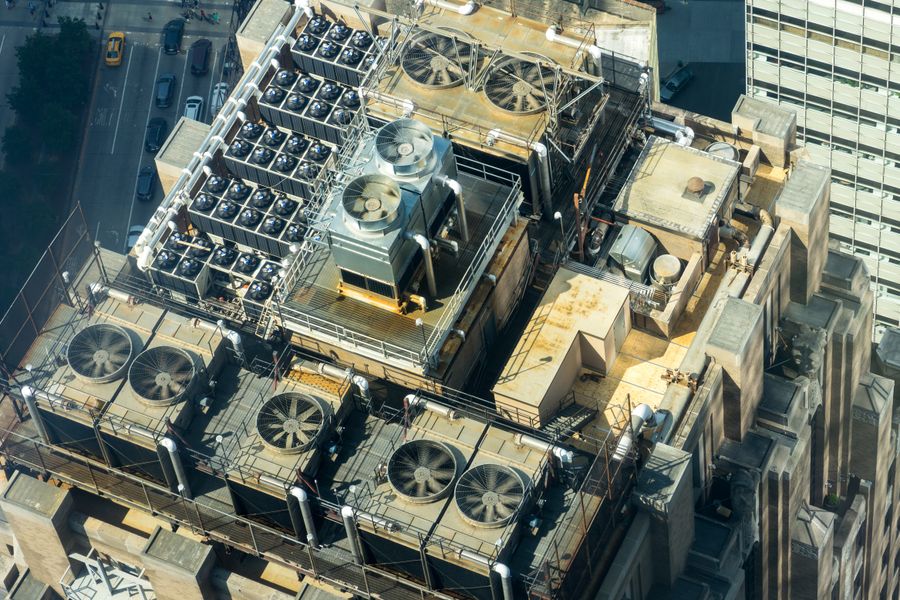
The thin-film, or falling-film, evaporator spreads liquid refrigerant as a thin layer over the outside of its tubes, the refrigerant boiling off that film, leaving the flooded shell behind. The thin film carries heat with a markedly higher coefficient than a flooded arrangement, the heat crossing a short path through a thin liquid layer, the boiling happening right at the surface where the load is.
The high coefficient buys two things the dry end needs. The temperature gap between the boiling refrigerant and the tube surface shrinks, so the metal the air touches runs closer to the refrigerant’s own cold temperature, the achievable dew point dropping toward the refrigerant, no longer lagging it by several degrees. The surface runs more uniform too, the thin film wetting the entire bundle evenly, the cold distributed across every tube, no longer pooling where flooded liquid sat, the warm spots that would cap the humidity ironed out.
The depth, the evenness both improve together from the same physics, which is why the evaporator design is no mere detail behind the dry-end specification; it is the root of it. A chamber quoting an aggressive low humidity stands on a coil that runs cold, runs even, the thin-film geometry one way that coil gets built to do both.
Reheat: drying then warming back
A subtlety follows from drying by a cold coil: the air leaves the coil cold as well as dry, yet the test may call for that dry air at a warm temperature. The chamber solves this by reheating, warming the dried air back up after the coil has stripped its water. The dew point stays low, set by the coil, while the temperature rises to the setpoint, the relative humidity dropping further as the warming air grows hungrier for water it no longer carries.
This reheat step is how a chamber reaches a low relative humidity at a warm temperature, a common test condition. The coil sets the absolute water content low, the reheat lifts the temperature, the combination producing the dry warm air the specification wants. The two stages divide the labour, the coil owning the water, the reheater owning the temperature, each adjustable without disturbing the other much.
The reheat also steadies control at the dry end. A coil left to chase temperature would cycle, warming when the air got cold, losing its grip on the dew point in the process. Splitting the duties lets the coil sit at one cold temperature, doing nothing but dry, the reheater handling every temperature move, the dew point holding steady underneath because the coil never has to leave its station.
The method in one line
The air leaves as dry as the coldest, evenest metal it touched, no drier.
The frost wall

Refrigeration dehumidification meets a hard wall at the freezing point. Above zero the water condenses as liquid film, draining away cleanly, the coil staying clear, the dehumidification steady. Below zero the same water freezes onto the coil as frost, a different problem entirely, the frost changing everything about how the coil behaves.
Frost attacks the coil three ways at once. It insulates, a layer of frost standing between the air and the cold metal, the surface the air actually touches now warmer than the coil beneath, the dehumidification weakening as the frost thickens. It blocks, the frost filling the gaps between fins, choking the airflow the dehumidification depends on, the coil starving for the air it is meant to dry. It sheds, the frost eventually defrosted or broken loose, dumping its accumulated water back as a humidity spike, the dry-end stability ruined by the very cycle meant to restore the coil.
The frost wall sets the clean floor of plain refrigeration. A chamber dehumidifying with a coil alone holds the dry end well down to a dew point near freezing, then loses its grip, the frost cycle introducing a wobble no amount of control tuning fully removes. Reaching below the frost wall cleanly means leaving refrigeration behind for a method that does not depend on a sub-zero surface, which is where the desiccant takes over.
Where the desiccant takes over
Below the frost wall the chamber hands dehumidification to a desiccant, a material that adsorbs water vapour directly onto its surface without any cold metal at all. Silica gel, activated alumina, the common desiccants pull water from the air by chemical affinity, reaching dew points far below anything a frosting coil could hold, down toward minus forty degrees, into the territory the dry end of a serious low-humidity chamber needs.
The desiccant runs as a wheel or a twin bed, one portion drying the air while another is regenerated by heat that drives off the water it captured, the two swapping so the drying never stops. A twin-tower system spends a fraction of its throughput, commonly fifteen to twenty percent, as purge air to carry the driven-off moisture away during regeneration, the cost of running continuously dry.
The refrigeration coil does not retire when the desiccant arrives, it moves to the front. The coil pre-cools the air, wringing out the easy water above the frost wall where refrigeration is efficient, handing the desiccant air already most of the way dry. The desiccant then takes the last, hardest stretch, the deep dew point the coil could never reach without frosting. The two work in series, each on the part of the range it handles best, the coil on the bulk water, the desiccant on the deep dryness. The division also spares the desiccant, since a desiccant fed raw humid air saturates fast, its capacity spent on water the coil could have taken cheaply, its regeneration cycling sooner than it should. Pre-cooling hands the desiccant a light load, the deep stretch only, the material lasting longer between regenerations for the labour the coil removed from it.
Reaching the coil’s cold temperature
A coil can only run as cold as the refrigeration behind it can drive the refrigerant, which sets a deeper limit on the dry end. A single-stage refrigeration system reaches a moderate cold; pushing the coil colder, toward the temperatures a low dew point needs, asks more of the refrigeration than one stage can give efficiently. The system answers with cascade refrigeration, one refrigeration circuit cooling a second, the second reaching the deep cold the coil needs to hold a low dew point.
This is why a deep low-humidity chamber carries the same refrigeration architecture as a deep cold chamber, the two sharing the problem of reaching a low temperature efficiently. The coil that dries to a low dew point is a cold coil first, the dehumidification riding on the refrigeration’s ability to chill it, the dry-end specification resting on the same cascade that a low-temperature specification would.
The link explains why low humidity costs what it does. Reaching a deep dew point means running a coil cold, running a coil cold means cascade refrigeration drawing steady power, so the dry end carries an energy cost the mid-range never pays. A chamber asked for both deep cold and deep dryness shares the refrigeration between the two duties, the coil serving as cold source for temperature work, as dehumidifier for the dry end, one cold surface doing two jobs.
The evaporator’s other half: even airflow
A cold, even coil dries the air that reaches it, which raises the question of whether all the workspace air actually reaches it. Dehumidification accuracy depends on the entire workspace volume passing across the coil often enough, the air circulation carrying every pocket of the chamber to the cold surface, returning it dried. A coil performing perfectly behind a poor airflow dries only the air that finds it, the corners of the workspace holding their moisture.
The thin-film coil’s even surface pairs with even airflow to give uniform dryness across the workspace. The two evennesses compound, an even coil fed by even airflow drying every part of the load alike, a uniform low humidity the specimen sees the same in every corner. A chamber that maps dry at the sensor, damp in a corner, has an airflow fault, not a coil fault, the cold metal doing its job on air that never visited the far corner.
This is why low-humidity accuracy is a system property, the coil, the fan, the ducting all bearing on the number. The evaporator sets the floor, the airflow decides whether the entire workspace reaches that floor, the two inseparable in any honest low-humidity specification.
Drying the air before it enters
Some low-humidity chambers attack the problem upstream, drying the make-up air before it ever reaches the workspace. A chamber that introduces fresh air, or one purged deliberately, can feed itself air already dried by an external source, the internal coil then holding a dryness the incoming air helped establish. A desiccant air dryer on the supply produces air at a dew point around minus forty degrees, dry enough that the chamber starts ahead of where its own coil could take it.
Nitrogen purge is the related move, feeding the workspace dry nitrogen that pushes the moist air out through a vent. Nitrogen carries almost no water, so injecting it drives the workspace below twenty percent humidity by displacement alone, the dry gas crowding out the damp, a slight positive pressure forcing the moist air through the vent port. The method trades gas consumption for a dryness the coil need not chase.
These upstream methods change where the drying happens without changing the physics. The water still leaves the air onto a cold surface or a desiccant somewhere, the chamber moving that surface outside itself, buying dry air ready-made. A specification that quotes a deep dry end may be leaning on a supply dryer as much as on its own coil, a distinction worth drawing when comparing two chambers that quote the same number.
Reading the dry-end number honestly
A low-humidity figure on a datasheet hides several questions the evaporator physics raises. The first is whether the figure is a dew point or a relative humidity, since the two diverge sharply at the dry end, a low relative humidity at high temperature meaning a far less demanding dew point than the same relative humidity at low temperature. A specification stated as dew point is the honest one, the absolute water content the coil actually has to reach.
The second is whether the figure is held loaded, the coil dragging down a workspace full of a heat-shedding, moisture-shedding specimen, or empty, the coil drying a still box. The loaded number is the real one, the specimen adding moisture the coil must clear as well, the dry end harder to hold against a load that breathes water of its own.
The third is whether the figure is steady or a best moment between frost cycles. A coil flirting with the frost wall can touch a low number briefly, then lose it as frost builds, the honest specification stating the humidity it holds continuously, the trace across hours showing whether the dry end is a plateau or a sawtooth of frost cycling into recovery.
Defrosting without spoiling the test
A coil that frosts must be defrosted, which collides with the test the chamber is running. Defrosting warms the coil to melt its frost, the warm coil briefly unable to dry, the workspace humidity rising during the thaw. A chamber dehumidifying with a single frosting coil faces a choice between a frosted coil that cannot dry, a defrosting coil that cannot dry either, the dry end interrupted both ways.
The cleaner designs sidestep the interruption. A chamber staying above the frost wall never frosts, never needs defrost, holding the dry end without a break, which is why the frost wall marks the boundary of easy low humidity. A chamber going below it carries either a desiccant that does not frost at all, or a dual-coil arrangement where one coil dries while the other defrosts, the duty handed back and forth so the drying never stops.
The single-coil chamber pushed below the frost wall betrays itself in the trace, the humidity sawing up at each defrost, down as the coil recovers, the dry end a series of recoveries rather than a hold. Reading that sawtooth on a datasheet trace tells a buyer the chamber is working past its clean frost-free limit, the low number real only in the troughs between defrosts.
Five ways the dry end falls short
The first failure is the warm coil spot, a coil that averages cold, carries a warm zone anyway, the humidity floor set by that warm patch, the air slipping past it carrying moisture the cold majority of the coil never gets to remove. An even coil is the fix, the thin-film geometry one route to it, the loaded humidity map the test that exposes the warm zone.
The second failure is the unmanaged frost, a coil run below zero with no defrost strategy, the frost building until the dehumidification collapses, the dry end wandering as the coil chokes. Either the design stays above the frost wall, or it adds the defrost, the desiccant the cycle the dry end needs to stay clean.
The third failure is the airflow shadow, a coil performing well behind a circulation that misses the corners, the sensor reading dry as a pocket of the workspace holds its moisture. The loaded map across the volume catches it, the airflow design the cure, the coil blameless.
The fourth failure is the relative-humidity disguise, a low number quoted as relative humidity at a temperature that makes it easy, the dew point behind it undemanding, the figure flattering the chamber. Reading the dew point strips the disguise, the absolute water content the figure the evaporator actually faces.
The fifth failure is the best-moment number, a dry-end figure captured between frost cycles, real for a minute, gone the next. The continuous trace is the audit, the held value the only honest claim, the sawtooth a confession the coil is working past its clean limit.
Why the dry end costs what it costs
The dry end of a low-humidity chamber carries a price the mid-range does not, the cost traceable to the same coil that sets the floor. Running a coil cold enough for a low dew point demands cascade refrigeration drawing steady power; pushing below the frost wall adds a desiccant with its own regeneration heat, its purge loss, its wheel or beds to maintain. Each step deeper into dryness adds equipment, adds energy, adds a maintenance burden the buyer carries for the life of the machine.
The depth wanted should match the depth needed, since over-specifying the dry end buys cost with no return. A test calling for a moderate low humidity runs on the coil alone, the cheapest path, the frost wall never approached. A test calling for a deep dew point justifies the desiccant, the cascade, the supply dryer, the full apparatus the deep dryness demands. Quoting the depth honestly against the test is what keeps a chamber from carrying dehumidification it never uses.
The maintenance follows the architecture into the service budget. A desiccant ages, its capacity fading as its surface fouls, the deep dry end drifting up as the material tires; the regeneration heater, the purge controls, the wheel drive each add a service item. A chamber bought for a deep dry end inherits a maintenance calendar a plain chamber never sees, the cost of holding the deepest dryness paid across every year the chamber runs, far past the purchase.
Reading the clause into a purchase
A chamber bought for low-humidity work answers on the dry end as a system. The dew point reached, stated as dew point over relative humidity, held loaded over empty, held continuously past any single frost cycle, evidenced by a trace across hours. The number means little without those qualifiers, since each one separates a real capability from a flattering one.
The dehumidification architecture follows the depth required. A moderate dry end leans on the evaporator alone, the specification asking how cold the coil runs, how even its surface, how it manages the approach to the frost wall. A deep dry end needs the desiccant, the specification asking for the wheel or the twin bed, the regeneration, the pre-cool coil ahead of it, the full train the deep dew point demands.
The evaporator detail rewards a direct question. A maker who can speak to the coil’s surface uniformity, its temperature approach to the refrigerant, its behaviour near the frost wall has engineered the dry end deliberately; a maker who quotes only a humidity range has left the buyer to discover where the real floor sits. The coldest metal in the machine deserves the most specific question on the order.
The coldest metal, accounted for
Low-humidity accuracy traces back through every layer to one cold surface. The dew point the chamber reaches is the temperature of the coil; the evenness of the dryness is the evenness of the coil; the stability of the dry end is the coil holding its temperature clear of the frost that would spoil it; the deepest dryness is the desiccant taking over where the coil’s frost wall stops it. A thin-film evaporator serves that chain by running its surface cold, uniform, close to the refrigerant, even across the bundle, the physics of a thin boiling layer turned into a lower, steadier dew point. The air leaves a low-humidity chamber as dry as the coldest, evenest, steadiest metal it touched, which is why the evaporator, hidden behind the panel, is the instrument the dry-end number ultimately reports on.
Questions laboratories ask about low-humidity dehumidification
How does a chamber actually remove moisture to reach low humidity?
By touching the air to a surface colder than its dew point. The refrigeration evaporator coil runs below the dew point, the air crossing it surrenders its water there as condensate or frost, the air returning to the workspace drier. Run continuously, the loop drives the workspace down toward the dew point the coil surface sets, so the coil temperature is the physical floor on the humidity the chamber can reach.
Why does the evaporator design affect accuracy so much?
Because the air can leave no drier than the coldest, evenest metal it touched. A coil that runs cold lowers the achievable dew point; a coil that runs uniform dries every part of the airflow alike, with no warm zone letting moisture past. A thin-film evaporator helps both, spreading refrigerant as a thin layer that carries heat efficiently, so the surface runs close to the refrigerant temperature, staying uniform across the bundle.
What is the frost wall?
The freezing point, where refrigeration dehumidification meets its clean limit. Above zero the water condenses as draining film; below zero it builds as frost that insulates the coil, blocks the airflow, then sheds as a humidity spike. Plain refrigeration holds the dry end cleanly down to a dew point near freezing, then loses steadiness to the frost cycle, so reaching below the frost wall calls for a desiccant; a colder coil cannot do it.
When does a chamber need a desiccant instead of a colder coil?
Below the frost wall, roughly a dew point under freezing. A desiccant adsorbs water vapour directly onto silica gel or activated alumina, with no cold surface to frost, reaching dew points toward minus forty degrees. The refrigeration coil moves to the front as a pre-cooler, wringing out the easy water above the frost wall, handing the desiccant air already most of the way dry for the deep final stretch.
Should a low-humidity figure be read as dew point or relative humidity?
As dew point, the absolute measure of water content the coil must reach. Relative humidity diverges from dew point sharply at the dry end, a low relative humidity at high temperature standing for a far less demanding dew point than the same figure at low temperature. A dew-point specification states what the evaporator actually faces, undisguised by the temperature the relative-humidity number was taken at.
Why must the dry-end number be held loaded, held continuously?
Because a load adds moisture the coil must clear as well, with a frosting coil able to touch a low number briefly before losing it. An empty, best-moment figure flatters the chamber; the loaded, continuously held figure is the real capability. The honest claim is a trace across hours with a specimen inside, showing the dry end as a steady plateau, far from a sawtooth of frost cycling into recovery.