Foundations · 02

A short walk through the history of the photocopier from Carlson to today

Almost everything an office uses to move paper around in 2026 traces back to a single sentence written in pencil on a glass slide on October 22, 1938, in a small lab above a beauty parlor in Astoria, Queens. The sentence read 10-22-38 ASTORIA. The man holding the slide had spent four years and most of his savings trying to make sulfur powder stick to a wax block.

The technology that came out of that experiment shaped office work for the next eighty eight years and still drives every laser MFP on sale today.

What offices used before any of this existed

Before xerography there was carbon paper, the mimeograph, the spirit duplicator, and the photostat. Carbon paper was good for one or two copies made at the moment of typing. The mimeograph and spirit duplicator handled volumes between fifty and a few hundred sheets but required a stencil cut on a separate machine and produced output that smelled of solvent and faded within a year. The photostat, introduced commercially in 1907, was a wet chemical process that produced a single negative image at a time. None of these technologies could produce a clean, dry, plain paper duplicate of an arbitrary document on demand. That gap is the reason an upstate New York patent attorney with bad arthritis spent a decade trying to invent xerography in his spare time.

Chester Carlson worked as a patent clerk at P. R. Mallory in New York City through the 1930s. The job required copying technical drawings by hand because the alternatives were too expensive or too slow. Carlson trained as a physicist at Caltech, then took night classes in law at New York Law School. He read German physics journals on his commute and got obsessed with one particular property of selenium plates: charged in the dark, they lose their charge wherever light strikes them. The four years between 1934 and 1938 were spent in his Astoria kitchen and a rented lab next door, working with his German refugee assistant Otto Kornei.

The first dry copy ever made

October 22, 1938. Carlson and Kornei coated a zinc plate with sulfur. They charged the sulfur surface by rubbing it with a handkerchief in the dark. They placed a glass microscope slide carrying the inked legend 10-22-38 ASTORIA against the charged sulfur and shone a 100 watt incandescent bulb on it for a few seconds. The glass slide blocked light where the ink sat. Carlson dusted the exposed sulfur with lycopodium powder. The powder stuck only to the parts of the sulfur that had stayed charged, the parts that the ink on the glass had blocked. He pressed wax paper against the powder, lifted, and held the wax paper up to the window. The legend appeared.

The image was crude, faint, and impossible to use commercially. Carlson took it home that night, showed his wife, and she told him to keep at it.

Between 1939 and 1944 Carlson was rejected by every company he approached. IBM passed twice. RCA passed. General Electric passed. Kodak passed. The list of rejection letters Carlson kept later filled a folder thicker than the patent itself. Battelle Memorial Institute in Columbus, Ohio finally took on the development work in 1944 in exchange for sixty percent of any future royalties. Battelle assigned a small team and budget. The first commercially viable copy plate took another three years.

How a small photographic paper company became Xerox

In 1947 a struggling photographic paper company in Rochester, New York named Haloid licensed the xerography patents from Battelle. Haloid had revenue of about seven million dollars at the time, mostly from photographic paper sold to professional studios. The CEO, Joseph Wilson, bet the entire company on xerography over the objections of his board. Haloid spent more on xerography research between 1948 and 1959 than the company earned in profit. Wilson named the new technology Xerox after the Greek for dry writing. The first product, the Xerox Model A, shipped in 1949 and required fourteen separate manual steps to make a single copy. It sold poorly.

By the mid 1950s Haloid was running out of money. The board nearly killed the project twice. Wilson kept it alive by mortgaging his house and convincing Battelle to defer royalties. The breakthrough was the Xerox 914, named for the maximum paper width it could handle, 9 by 14 inches. The 914 fully automated the xerographic process. Insert original. Press button. Wait twelve seconds. Take the dry copy from the output tray. The everyday distinction between what the 914 did and what the printers and standalone scanners around it could do is a separate piece, How a photocopier differs from a printer an MFP and a copier in everyday office life.

1959 and the office machine that broke every estimate

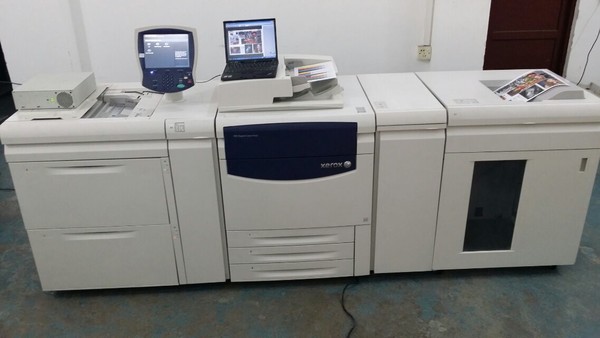
Haloid Xerox launched the 914 on September 16, 1959 at a press demonstration at the Sherry Netherland Hotel in New York. The machine weighed 295 kilograms. List price was 29,500 dollars. Wilson decided to lease the machine instead of selling it, at 95 dollars a month plus four cents per copy above the first 2,000 copies a month. Internal Xerox forecasts predicted maybe 8,000 placements over five years.

By 1961 Haloid Xerox had renamed itself Xerox Corporation. By 1965 there were 200,000 Xerox 914 machines in service. By 1968 the company was generating over a billion dollars in revenue per year, almost entirely from one product line. The 914 was on the cover of Fortune in 1962 and listed by Fortune in 1986 as one of the most successful product introductions in American business history. The simplest possible read on what an MFP today does that the 914 did not is at The simplest possible explanation of what a multifunction printer does.

200,000 machinesThe number of Xerox 914 units in service by 1965, six years after launch. Internal forecasts before launch had estimated 8,000 over five years.

The 914 had one quirk that became part of office mythology. The fuser ran hot enough that paper occasionally caught fire when jammed. Every machine shipped with a small fire extinguisher, marketed by Xerox as the Scorch Eliminator. Service technicians learned to keep one near every installed unit. Modern fusers run at much lower temperatures, around 175 to 195 degrees Celsius, and the fire risk has been engineered out, although every modern MFP still has a thermal cutoff in the fuser unit for the same reason.

The Japanese reset of the 1970s and 1980s

Xerox held a near monopoly on plain paper copying through the late 1960s. The expiration of key xerography patents in 1973, combined with a 1975 antitrust consent decree forcing Xerox to license its patent portfolio at low rates, opened the market to Japanese competition. Canon launched the NP-1100 in 1970, the first non Xerox plain paper copier. Ricoh followed with its first plain paper copier in 1972. Sharp, Minolta, Konica, and Toshiba entered through the rest of the decade. Canon introduced the first commercial color copier, the NP-L7, in 1973.

By 1980 the Japanese brands had captured roughly 40 percent of the global office copier market. By 1990 the share was over 70 percent. The shift was driven by lower price points, smaller form factors, and aggressive sales channels. Canon's tabletop NP-150 in 1982 brought a plain paper copier under 1,000 dollars for the first time. Ricoh's Aficio line, introduced in 1995, became the de facto standard mid market machine across Europe and Asia. Where the line between an office class machine and a production class one sits today, after several waves of segment shuffling, is unpacked at How to tell whether you need an office class copier or a production class one.

The digital pivot of the 1990s

The copier market through 1995 was almost entirely analog. A copier received a sheet of paper, scanned it with lamp and mirror onto a charged drum, and produced output. There was no intermediate digital representation. Print jobs from a computer required a separate printer. Then between 1995 and 2002 every major brand pivoted to digital architecture.

Canon launched the imageRUNNER 330 in 1999 as the first imageRUNNER series digital copier. Xerox launched the DocuCenter line in 1996. Ricoh moved its Aficio line to digital in 1998. Konica Minolta followed with the bizhub line in 2000. The shift made network printing native to the copier. The same machine could now receive print jobs over Ethernet, scan documents to email, store jobs on an internal hard drive, and run software apps on its embedded controller. The marketing labels three in one, four in one, and five in one all date from this transition, and the differences between them are explained at The real differences between three in one four in one and five in one printers.

The digital pivot also killed the standalone copier category. Buying a copier in 2002 increasingly meant buying an MFP, the abbreviation that became standard industry shorthand around 2004. Single function copiers continued to ship through the late 2000s, mostly into government and high security environments, but the office market had moved on. The case for staying with single function units in specific scenarios, even today, sits at When a single function printer makes more sense than a multifunction one.

Networked offices and the segment system that came with them

As digital MFPs proliferated through the 2000s, the question of how to compare them got messy. A 30 page per minute Canon iR3300 had different paper handling, finishing options, and durability than a 30 page per minute Ricoh Aficio MP3500. Buyers Lab, the independent testing house that had been reviewing copiers since the 1960s, formalized a segment classification numbered one through six during this period. The segments stuck. Every dealer quote in 2026 still uses them. The mapping of segment number to feature expectations and durability is at What the industry copier segments from one through six actually mean for you.

Konica Minolta merged in 2003. Toshiba launched the e-STUDIO line in 2002. Sharp introduced its MX series in 2005. Canon acquired Oce in 2010, picking up the Oce wide format and production lines. HP entered the MFP market through its 2017 acquisition of Samsung Electronics' printer division, rebranding the lineup as HP LaserJet MFP. Lexmark spun out of IBM in 1991 and was acquired by a Chinese consortium in 2016. The market consolidated rapidly through the 2010s. By 2025 the worldwide office copier market was effectively six brands, with Canon, Ricoh, and Xerox still leading by unit volume.

The cloud and OAuth shift that reshaped the controller

The decade between 2014 and 2024 was the second major architectural shift after the digital pivot. The 1990s pivot had moved the print engine from analog to digital. The 2010s pivot moved the controller from local network appliance to cloud connected workstation. Xerox introduced the ConnectKey platform in 2013. Canon expanded uniFLOW. Ricoh shipped Smart Operation Panel. Kyocera launched HyPAS. The platforms differed in branding but shared a single direction of travel. Turn the MFP into an extension of Microsoft 365, Google Workspace, and the cloud document repositories.

The OAuth shift came later. Through about 2020, scan to email on most office MFPs used SMTP with a stored password. Google deprecated less secure app password authentication in May 2022. Microsoft phased out basic authentication on Exchange Online in October 2022. Every MFP brand scrambled to ship firmware updates supporting OAuth 2.0 to keep scan to email working. By 2023, OAuth was the standard authentication mode for cloud connectors across the industry. Older machines without firmware support became scanners that could no longer email, and a wave of forced replacements followed in late 2023 and through 2024.

The other big shift in the same window was security. RGPD enforcement in Spain, GDPR across the EU, and HIPAA in the US made the encrypted hard drive inside every MFP an audit item. AES 256 became standard. Disk wipe routines became standard. The decommissioning protocol for an end of lease machine became a documented step in the procurement cycle, at least on paper.

Where 2026 sits in the timeline

Eighty eight years after Carlson dusted lycopodium powder onto a zinc plate in Queens, the photocopier on a Spanish office floor runs the same six step electrostatic process. Charge a drum. Expose with a laser. Develop with toner. Transfer to paper. Fuse with heat. Clean the residual. The mechanical core has been polished, miniaturized, and made more reliable, but the underlying physics has not changed.

What has changed is everything around the print engine. The controller now talks to OAuth providers. The hard drive carries encryption mandated by regulation. The scanner reaches Google Drive and OneDrive natively. The fleet management runs from a cloud dashboard. The service contract is sold by the page rather than by the machine. The business model that Joseph Wilson invented in 1959, leasing rather than selling and billing for usage, is the model every dealer in Europe and North America now runs by default.

Carlson did not live to see most of this. He died of a heart attack in a Manhattan theater in 1968 at the age of 62, holding the playbill for He and She. By the time of his death he had given away most of his Xerox royalties to charity, anonymously. The Xerox 914 he made possible had become the best selling industrial product in American history up to that point.

The photocopier as an object has outlived nearly every other piece of office hardware introduced in the same generation. Typewriters left. Mimeographs left. Fax machines as standalone devices have left. The xerographic copier, eighty eight years on, has not.

滚动至顶部